A distinctive Middle Helladic pottery – a gray or yellow wheelmade ware of high quality first appearing at Troy VI and in Greece c. 19th century bc. It was the first wheelmade pottery to be produced in Middle Bronze Age Greece. It was ancestral to Mycenaean pottery, and may represent a movement of new peoples into the Aegean area, the first Greek speakers. Traditionally it has been associated with an apparently violent end to the Early Helladic culture, c. 2000–1900 bc, and the arrival of Greek-speaking peoples in the Aegean. The term was coined by Heinrich Schliemann. The ware had a soap-like feeling and its forms were modeled after metal objects.
greek etiketine sahip kayıtlar gösteriliyor. Tüm kayıtları göster
24 Nisan 2020 Cuma
21 Nisan 2020 Salı
WHAT IS THE MEGARIAN BOWL?
A handleless hemispherical Greek drinking cup made in molds and often decorated in relief and finished in the black glossed technique. Widespread in the Hellenistic period from the 3rd century bc, they developed into the red-glossed Arrentine wares. The type was first recognized at Megara and they were made until the 1st century ad. They were imitations of gold and silver vessels and served as the first form of book illustration. They often bear on their exteriors scenes in relief from literary texts that are sometimes accompanied by Greek quotations. They likely served as models for Roman artists who created the first true book illustrations.
19 Nisan 2020 Pazar
WHAT IS THE LARNAX?
1. A Minoan-Mycenaean clay or terra cotta coffin. This kind of coffin, resembling a rectangular wooden chest, enjoyed a brief popularity in the eastern Greek region c. 530-460 bc. The sarcophagus was often crudely painted on the sides with funerary or religious scenes. “Clazomenian” examples were painted in imitation of contemporary vase styles. 2. The term was also used for a closed box, seen in a royal tomb at Vergina, and in art. 3. A bathtub made of a fabric containing straw.
Etiketler:
ancient greek,
greek,
larnax,
minoan,
mycenaean
17 Nisan 2020 Cuma
WHAT IS THE KYLIX?
A Greek stemmed drinking cup or chalice, usually made of clay or metal. The term was originally used for a cup of any form, but modern scholars restrict it to shallow two-handed stemmed forms. This wide-bowled drinking cup with horizontal handles was one of the most popular pottery forms from Mycenaean times through the Classical Athenian period. There was usually a painted frieze around the outer surface, depicting a subject from mythology or everyday life, and on the bottom of the inside a painting often depicting a dancing or drinking scene.
16 Nisan 2020 Perşembe
WHAT IS THE KRATER?
Ancient Greek vessel used for diluting wine with water. It usually stood on a tripod in the dining room, where wine was mixed. Kraters were made of metal or pottery and were often painted or elaborately ornamented. In Homer’s Iliad the prize offered by Achilles for the foot race at Patroclus’ funeral games was a silver krater. The Greek historian Herodotus describes many enormous and costly kraters dedicated at temples or used in religious ceremonies. Kraters are large, with a broad body and base and usually a wide mouth. They may have horizontal handles placed near the base, or vertical handles rising from the shoulder. Among the many variations are: the bell krater, confined to red-figure pottery, shaped like an inverted bell, with loop handles and a disk foot; the volute krater, with an egg-shaped body and handles that rise from the shoulder and curl in a volute (scrollshaped form) well above the rim; the calyx krater, the shape of which spreads out like the cup or calyx of a flower; and the column krater, with columnar handles rising from the shoulder to a flat, projecting lip rim. Some were fitted with a strainer.
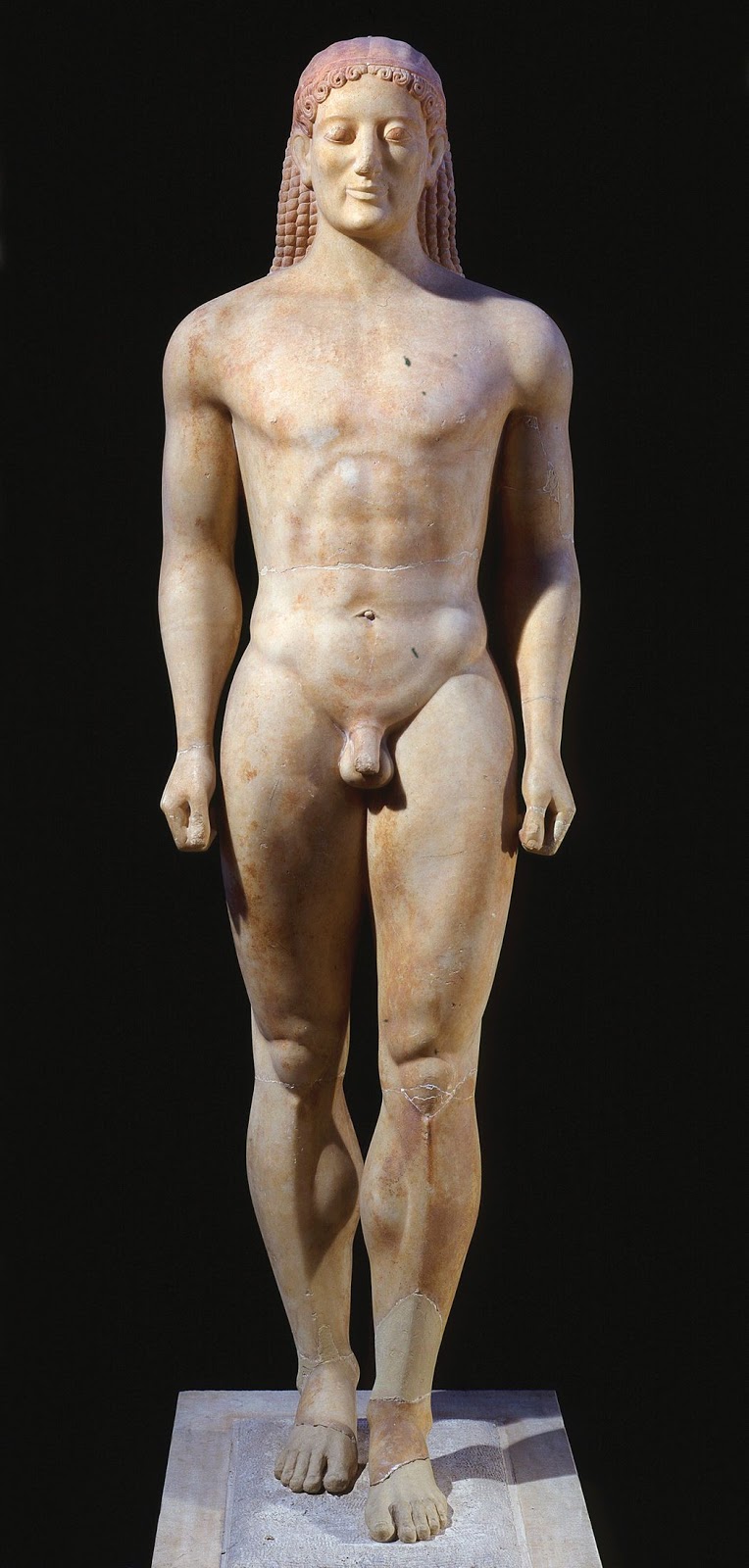
WHAT IS THE KOUROS?
A Greek statue of a youth or a standing nude male youth, of the Archaic period. The large stone figures began to appear in Greece about 615–590 bc. They were funerary markers or dedications in sanctuaries. They were usually larger than life size, made of marble, bronze, or alabaster, and were sometimes painted. The kouros is thought to have been influenced by Egyptian sculpture; the first appearance of such monumental stone figures seems to coincide with the reopening of Greek trade with Egypt in c. 672 bc. The kouros remained a popular form of sculpture until about 460 bc. The female equivalent is called a kore.
WHAT IS THE KORE?
A type of freestanding statue of a maiden – the female counterpart of the kouros or standing youth – that appeared with the beginning of Greek monumental sculpture in about 660 bc and remained to the end of the Archaic period in about 500 bc. It evolved from a highly stylized form to a more naturalistic one. The statue was usually draped, carved from marble, and painted in its original form. They are often dedications in sanctuaries and some are found in funeral contexts. Important series were in the temple of Hera on Samos and on the Acropolis in Athens.
15 Nisan 2020 Çarşamba
WHAT IS THE KLEROTERION?
An ancient machine used to decide who would serve on a jury in courts of law. There are surviving examples, such as the one from the Agora at Athens. Different colored balls would drop when tickets were inserted; the color determined acceptance or rejection.
13 Nisan 2020 Pazartesi
WHAT IS THE KERNOS?
Greek cult vessel – dish, bowl, or jar – made of terra cotta or stucco-covered, sun-baked brick and used for the offering of first fruits. The jar held small cups around its lip and examples are found from the Bronze Age onwards.
11 Nisan 2020 Cumartesi
WHAT IS THE HYDRIA?
A form of Greek water pot; a large jar or pitcher for carrying water with two or three handles. The body was bulbous, the neck round. It was wider and usually lower than the amphora and it had a welldefined foot and neck. There were two horizontal loop handles on the body for carrying and one vertical handle from the rim to the shoulder for pouring.
9 Nisan 2020 Perşembe
WHAT IS THE HELLENISTIC PERIOD?
Period of the widest Greek influence, the era between the death of Alexander the Great (323 bc) and the rise of the Roman Empire (27/30 bc), when a single, uniform civilization, based on Greek traditions, prevailed all over the ancient world, from India in the east, to Spain in the west. During these three centuries, Greek culture crossed many political frontiers and spread through many cities founded at that time, especially the new capitals of Alexandria, Antioch, and Pergamum. A common civilization became established throughout the known world for the first time, one which integrated the cultural heritage of each region and subsequently left a deep impression on the institutions, thought, religions, and art of the Roman, Parthian, and Kushan Empires. The Hellenistic cultural influence continued to be a powerful force in the Roman and Parthian Empires during the early centuries ad.
27 Aralık 2016 Salı
WHAT IS THE DOLIUM ?
A large Greek or Roman coarse earthenware vessel with a wide mouth and spherical form. It was used to store wine and oil; later, smaller vessels were produced. [culeus]
26 Mart 2015 Perşembe
WHAT IS THE AMULET ?
AMULET: small good-luck charms, often in the form of gods, hieroglyphs, and sacred animals and made of precious stones or faience. They were especially popular with Egyptians and other Eastern peoples, worn in life and placed in burials or within mummy wrappings. Amulets were supposed to afford protection and may have been thought to imbue the wearer with particular qualities. Some superstitiously thought amulets could heal diseases or help the wearer avoid them. [meket, nehet, periapta, sa, wedja]
![]() |
| A Roman Silver Tri-penis Amulet |
WHAT IS THE AMPULLA ?
AMPULLA: A small Greek or Roman globular flask or bottle with two handles and a short narrow neck. It was used for holding oil for bathers (called ampulla oleria) or wine, oil, vinegar, and other beverages for table use (then called ampulla potaria). These small containers were usually the form of a globe or bladder, though sometimes shaped like a lentil with rounded sides. [ampullae (pl.)]
WHAT IS THE AMPHORA ?
AMPHORA: A large Greek or Roman earthenware storage jar, with a narrowneck and mouth and two handles (“two-eared,” each called an anem) at the top. The body of the jar is usually oval and long, with a pointed bottom. It was used for holding or transporting liquids, especially wine or oil, and other substances such as resin. Its shape made it easy to handle and ideal for tying onto a mule’s or donkey’s back. They were often placed side by side in upright positions in a sandfloored cellar; sinking them into the sand or ground kept the contents cool. Amphorae were also made of glass, onyx, gold, stone, and brass and some had conventional jar bottoms with a flat surface. The container
would be sealed when full, and the handle usually carried an amphora stamp, impressed before firing, giving details such as the source, the potter’s name, the date, and the capacity. Amphorae were probably not normally reused. [amphorae (pl.)]
WHAT IS THE AMARNA PERIOD ?
AMARNA PERIOD: phase in the late 18th dynasty, including the reigns of Akhenaten, Smenkhkare, Tutankhamen, and Ay (1379–1352 bc), when important religious and artistic changes took place. The name is derived from the site of Akhenaten’s capital at Tell el-Amarna.
WHAT IS THE ALEXANDIRINUM ?
ALEXANDIRINUM: a type of mosaic used especially for Roman rooms, notably in the 9th century. It used tiny, geometrically shaped pieces of colored stone and glass paste that were arranged in intricate geometric patterns dotted with large disks of semiprecious stones. It often was of only two colors, red and black, on a white ground.
WHAT IS THE ALBARIUM ?
ALBARIUM: A white lime coating or type of stucco used in Roman times, used to cover brick walls after cement was applied. The mixture contained chalk, plaster, and white marble.
Etiketler:
albarium,
ancient egypt,
ancient greek,
ancient rome,
archaeology,
greek,
romans
WHAT IS THE ALABASTRON ?
ALABASTRON: a Greek container made of alabaster, but sometimes clay, used for unguents. [alabastrum]
25 Mart 2015 Çarşamba
WHAT IS THE AEGINETAN MARBLES ?
AEGINETAN MARBLES: archaic Greek sculpture discovered in the temple of Pallas-Athene at Aegina, an island in the Saronic group of Greece. They are in the Glyptothek at Munich, Germany. Aegina’s period of glory was the 5th century bc, which left a legacy of sculpture.
Etiketler:
aceramic,
aceramic neolithic,
aeginetan marbles,
ancient egypt,
ancient greek,
ancient rome,
archaeology,
greek,
native american culture,
neolithic,
paleolithic,
prehistory,
romans
Kaydol:
Kayıtlar (Atom)