Neolithic: the period of prehistory when people began to use ground stone tools, to cultivate plants, and to domesticate livestock, but before the use of metal for tools. It is the technical name for the New Stone Age in the Old World following the Mesolithic. In the Neolithic, villages were established, pottery and weaving appeared, and farming began. The Neolithic began about 8000–7000 bc in the Middle East and about 4000–3000 bc in Europe. It was followed by the Bronze Age, which began about 3500–3000 bc in the Middle East and about 2000–1500 bc in Europe. The criteria for “defining” the Neolithic has become progressively more difficult to apply as both food production and metalworking took a long time to develop. In Britain, the Neolithic has other more specific characteristics: the use of pottery and of ground stone (beside the long-employed flaked stone), and the appearance of construction works like the long barrow, causewayed camp, and megalithic tomb. Elsewhere, however, some Mesolithic cultures made use of pottery, in Japan for example; and certain so-called Pre-Pottery Neolithic groups had none, as at Jericho. If the term Neolithic is to be retained at all, it must be based on the appearance of food production (especially cereal grains), sometimes called the Neolithic Revolution, commencing in southwest Asia 9000–6000 bc. This might be considered the most important single advance ever made by man, since it allowed him to settle permanently in one spot. This in turn encouraged the accumulation of material possessions, stimulated trade, and by producing a storable surplus of food allowed a larger population and craft specialization. All these were prerequisite to further human progress. The Neolithic was followed by the Mesolithic period, the Chalcolithic, or the Bronze Age, depending on the terminology used in different areas and the nature of the archaeological sequence itself. The Neolithic followed the Paleolithic period
neolithic etiketine sahip kayıtlar gösteriliyor. Tüm kayıtları göster
20 Aralık 2021 Pazartesi
25 Nisan 2020 Cumartesi
WHAT IS THE MORTLAKE WARE?
A family of elaborately decorated Neolithic ceramics found in southern and eastern parts of the British Isles. Dating to the period 3000–2000 bc, Isobel Smith divided Peterborough wares into three successive styles – Ebbsfleet, Mortlake, and Fengate – on the basis of their occurrence in the ditch fills at Windmill Hill. It is now recognized that these three groups overlap rather more than originally thought, and that they are best seen as part of the broad group of impressed wares found over much of northern Europe in the 3rd millennium bc. The decoration on Peterborough ware consists of pits, “maggot impressions” made by impressing tightly rolled cord, and the impressions made by pressing the ends of bird bones into the soft clay before firing. Some of the later vessels are the first in Britain to be made with flat bases. [Peterborough ware]
Etiketler:
ancient,
england,
mortlake ware,
neolithic,
petersborough ware,
pottery,
ware
11 Nisan 2020 Cumartesi
WHAT IS THE IMPRESSED WARE?
Earliest Neolithic pottery of the Mediterranean area, with decoration impressed into the clay by sticks, combs, fingernails, or seashells, from before 6000 bc to around 4000 bc (though until later in North Africa). The pottery itself was characterized as having simple, round-bottomed shapes. The serrated edge of the cardium shell was particularly popular in the western area, giving the alternative name of Cardial ware. Before c. 5000 bc the ware is found mainly in caves or rock shelters or shell midden sites, where it was associated with hunting-gathering and the breeding of sheep. Around 5000 bc, crop cultivation was introduced and large settled villages sprang up. Other types of pottery are found alongside Impressed ware at this stage, including fine red-painted ware in Italy, Stentinello ware in Sicily, and Ghar Dalam ware in Malta, which represent specialized versions of Impressed ware. The pottery style may have originated in Asia Minor or even Yugoslavia (Starcevo culture).
10 Nisan 2020 Cuma
WHAT IS THE HEMBURY WARE?
A type of plain Early and Middle Neolithic pottery found in southwestern England in the 4th millennium bc, characterized by round-bottomed vessels with straight sides or S-profiled bodies.
9 Nisan 2020 Perşembe
WHAT IS THE HELL GAP?
A Plano tradition complex of the Paleoindian period from c. 11,200 to 8000 bc (the complex dates to c. 10,000–9500 bp) and centered on a well-preserved, deeply stratified site in eastern Wyoming. Hell Gap is also the name of a projectile point type of the Plano tradition, which is bifacially worked with a broad pointed top set on a straight-sided trapezoidal body. The base is narrow and straight. Experiments show that these points were probably spearheads and fully capable of penetrating the hide and ribcage of large beasts such as bison.
6 Nisan 2020 Pazartesi
WHAT IS THE HALAF?
A large tell site on the Khabur River in northeastern Syria near the Turkish border, which is the type site of an important stage of north Mesopotamian development, roughly from the 6th millennium bc to the beginning of the 5th millennium (5050–4300 bc). The distinctive pottery, known as Halaf ware, was exceptionally fine – a thin hard ware in a wide range of competent and attractive shapes bearing brilliant carpet-like designs painted in black, red, and white on the buff surface. Simple steatite stamp seals were coming into use, which imply the development of personal property. In the villages, the typical dwelling was a round house with a vaulted dome (tholos), constructed of mud brick, sometimes on stone foundations. The Halaf culture was succeeded in northern Mesopotamia by the Ubaid culture. It was the seat of an Aramaean kingdom and then a provincial capital of the Neoassyrian Empire. In 808 bc, Adad-nirari III of Assyria sacked the city and reduced the surrounding district to a province of the Assyrian Empire. The Assyrian archives provide valuable details of the administrative affairs of the time. It was the Old Testament “Gozan” to which the Israelites were deported in 722 bc after the capture of Samaria.
Etiketler:
halaf,
late neolithic,
mesopotamia,
near east,
neolithic,
Turkey
4 Nisan 2020 Cumartesi
WHAT IS THE GROOVED WARE?
A pottery style of the British Late Neolithic, widely distributed c. 2750–1850 bc. The characteristic vessel is flat based with straight vertical or outward sloping walls. It was formerly known as Rinyo-Clacton after two widely separated findspots (Clacton in Essex and Rinyo in the Orkney Islands). Throughout eastern and southern England, where it is particularly frequent on henge sites (Stonehenge
and Durrington Walls), it is decorated with shallow grooving or sometimes with applied cordons. A Scottish group, where appliqué cordons were much used in addition, is represented in Orkney at sites like Rinyo and Skara Brae. It is also found in settlement sites and in chambered tombs.
WHAT IS THE GRIMSTON WARE?
A type of Early and Middle Neolithic pottery of northeast
England, characterized by fine fabrics, good-quality finish, and round-bottomed forms with a carinated profile.
6 Nisan 2017 Perşembe
WHAT IS THE ENOLITHIC ?
a period in the Near East and southeastern Europe when copper metallurgy was being adopted by Neolithic cultures, in the 4th and 3rd millennia bc. The period is called the Chalcolithic in the Near East and the Copper Age in other areas.
9 Haziran 2015 Salı
WHAT IS THE CUMB AND RING MARK ?

CUMB AND RING MARK: The commonest form of rock carving in the British Isles, consisting of a cuplike depression surrounded by one or more concentric grooves. Cup-and-ring marks are found on standing stones, singular or in stone circles, and on the slabs of burial cists, as well on natural rock surfaces. In its classic form most cup-and-ring art belongs in the Bronze Age, but the motif occurs on passage graves, for example in the Clava tombs and on the capstones at Newgrange, where it may show links with similar rock carvings in northwest Spain. They are also found in Ireland and Scotland and can be dated to the Neolithic period of the 4th to 3rd millennium bc.
25 Nisan 2015 Cumartesi
14 Nisan 2015 Salı
WHAT IS THE CORDED WARE ?
CORDED WARE: a Late Neolithic pottery ware decorated with twisted cord ornament found over much of north and central Europe in the 2nd half of the 3rd millennium bc. The commonest shapes are the beaker and the globular amphora. The ware is always associated with early agriculture, the stone battle ax, and usually with single burial under a small barrow or kurgan. The ware may derive from Denmark, central Germany (Saxo-Thuringia), eastern Poland, or the Ukraine. The culture received its name from the characteristic pottery. Some groups also had metal artifacts. There is some evidence that Corded ware people had domesticated horses and wheeled vehicles, and they are sometimes interpreted as nomadic groups – possibly Indo-European speaking – who spread across northern Europe from the east. Closely related are the Globular amphora and Funnel beaker cultures.7 Nisan 2015 Salı
WHAT IS THE CARVED STONE BALL ?
CARVED STOEN BALL :Any roughly spherical or slightly lobate, artificially shaped, carved stones of the later Neolithic and found only in Scotland. The motifs are similar to those in megalithic art. Undecorated stone balls are found in other areas of the British Isles from around the 4th and 3rd millennia bc.WHAT IS THE CARROWKEEL WARE ?
CARROWKEEL WARE: A type of later Neolithic pottery found in Ireland during the 3rd millennium bc. The fabric is generally thick, coarse, and heavily gritted and there are open round-bottomed bowls and hemispherical cups. Decoration is often all over the outer surface of the vessel and the rim, “stab and drag,” or impressed.6 Nisan 2015 Pazartesi
WHAT IS THE CALLAIS ?
CALLAIS: A greenish decorative stone occasionally used for beads from the Late Neolithic to Early Bronze Age in western Europe.
5 Nisan 2015 Pazar
WHAT IS THE BUBALUS PERIOD ?
BUBALUS PERIOD: The earliest phase of rock art in northern Africa, between 12,000 and 8000 bc, in which large-scale carvings of animals appeared. These early engravings – in southern Oran, Algeria, and Libya – reflect a hunting economy based on the now-extinct giant buffalo Homoioceras antiquus or Bubalus antiquus (hence the name).
2 Nisan 2015 Perşembe
WHAT IS THE BI DISK ?
BI DISK: A flat jade disk with a small hole in the center, made in ancient China for ceremonial purposes, possibly symbolizing heaven. Bi disks have also been described in ancient Chinese texts as a symbol of rank. Jade disks and disklike axes have been found in 4th and 3rd millennium bc graves at east-coast Neolithic sites such as Beiyinyangying. Polished stone disk segments are known still earlier at Banpo. [bi]
1 Nisan 2015 Çarşamba
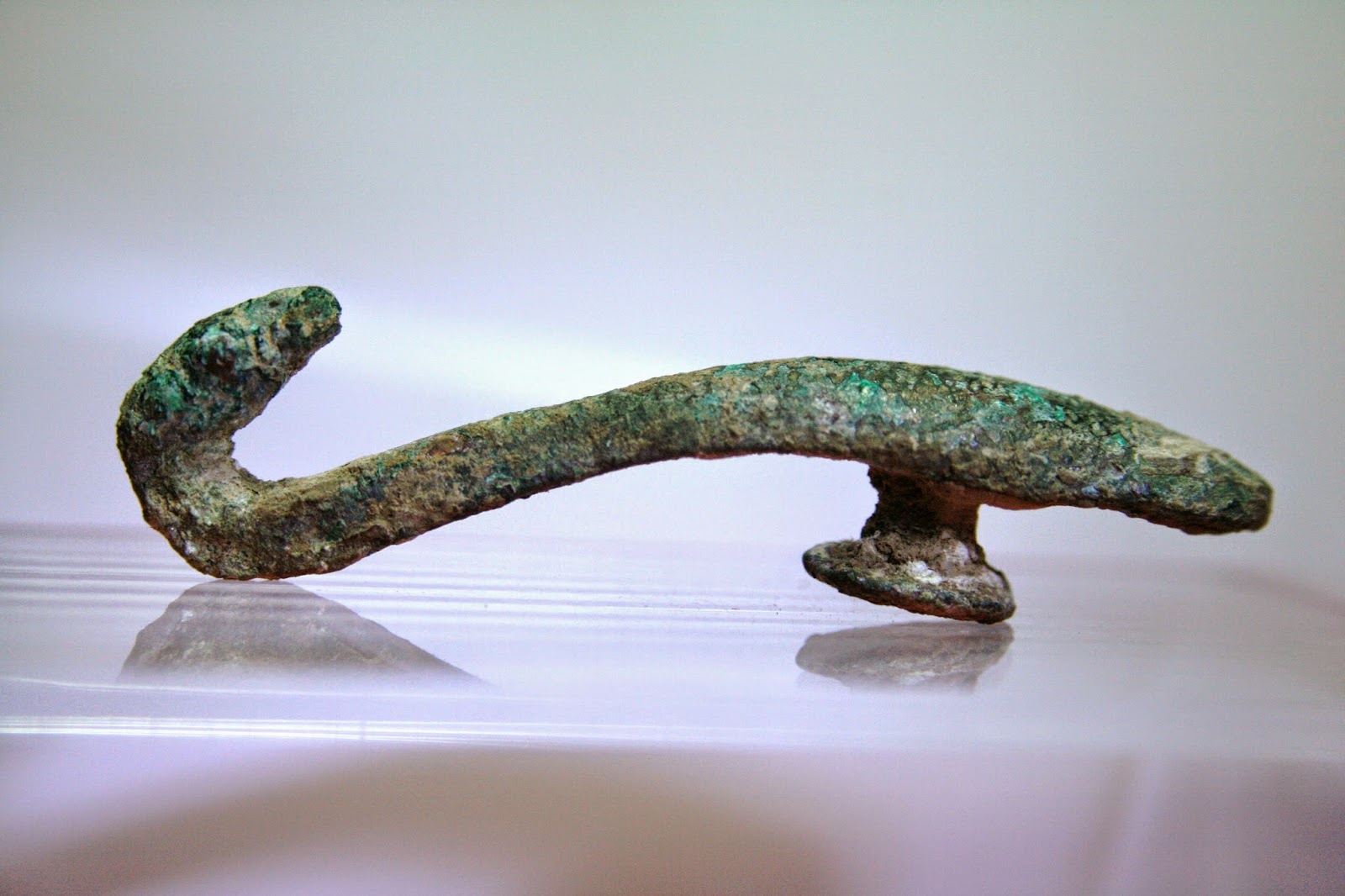
WHAT IS THE BELT HOOK ?
BELT HOOK: small decorative and functional object used as a garment hook in China, Korea, and other Near Eastern areas as early as the 7th century bc. Belt hooks have been found in Han tombs in southwestern China, but this luxury item was most in vogue during the Warring States period (5th to 3rd centuries bc). These belt hooks were inlaid with gold or silver foil, polished fragments of turquoise, or more rarely with jade or glass; sometimes they were gilded. Most examples are bronze, often lavishly decorated with inlays, but some are made of jade, gold, or iron. The belt hook consists of a bar or flat strip curving into a hook at one end and carrying at the other end, on the back, a button for securing it to the belt. The hooks vary widely in size, shape, and design, and although contemporary sculptures sometimes show them at the waists of human figures, some examples are far too large to have been worn and their function is unclear. Textual evidence hints that the belt hook was adopted by the Chinese from the mounted nomads of the northern frontier of inner Asia, perhaps
along with other articles of the horseman’s costume. They were probably worn by both men and women. [toggle]
Etiketler:
ancient,
archaeology,
archaic,
belt hook,
neolithic,
prehistoric,
prehistory
WHAT IS THE BELL BEAKER ?
BELL BEAKER: A type of pottery vessel found all over western and central Europe from the Final Neolithic or Chalcolithic, c. 2500– 1800 bc. The culture’s name derives from the characteristic pottery, which looks like an inverted bell with globular body and flaring rim. The beakers were valuable and highly decorated. They are often associated with special artifacts in grave assemblages, including polished stone wristguards, V-perforated buttons, and copper-tanged daggers.
WHAT IS THE BELGIC POTTERY ?
BELGIC POTTERY: General term sometimes applied to the range of Late Iron Age wheel-turned pottery vessels found in southeastern England, especially Aylesford-Swarling pottery.
Etiketler:
archaeology,
archaic,
belgic pottery,
neolithic,
paleolithic,
pottery,
prehistory
Kaydol:
Kayıtlar (Atom)